
Experimentals: The Series Vol. 1
INTRO: You will see this before every Experimentals volume.
The gears are always a turning in my head. So many ideas that normally just fizzle due to time or complexity. Those that make their way to the virtual workbench I might just post up here. I want to showcase some of the ideas that I have had that seemed like a good idea at some point. What you may see here are 3D prints that are probably not final revisions, but most likely the starting point of an idea that deserves discussion or further development. Sometimes I get some idea for a product that just seems cool and sometimes they are a real solution to a problem I have had.
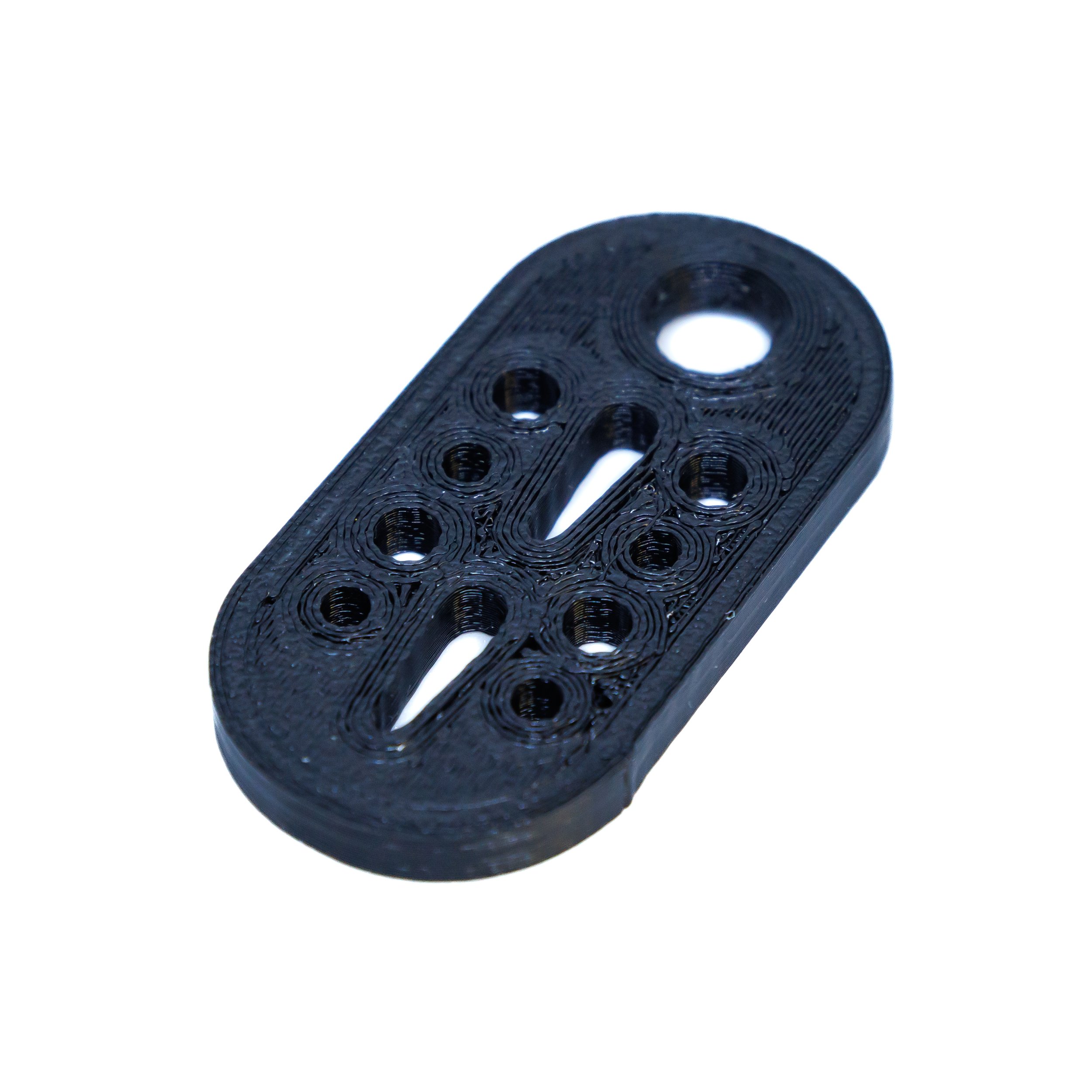
Above is a 3D printed insulator. Please excuse the poor quality print, it was just a quick prototype. This was an idea I had to solve a real world problem of mine, and possibly yours too. Let me try to explain. I have built or bought many wire antenna throughout my ham radio hobby journey, dipoles being my favorite due to the easiest and simplest. you need insulators, or not, but most of time you use them on the ends of your dipole ends. I have always used the plastic or ceramic type. How I attached the wire to said insulator is the part I struggle with. I’m sure many will say I am just doing it the wrong way, and that’s fine. Everyone has their own way of doing things. I usually feed the wire through the insulator, fold it over itself, twist it around itself and either tape or zip tie to hold it together. Now if you have to cut to tune your dipole, you have to untape, or cut your zip ties and start over. This 3D printed insulator was an experiment to see if I could make a part in which I could feed the wire through a couple of holes and not have to fold the wire upon itself to keep it secure. Cutting and tuning would be so much easier if this works. As of this writing, I have not tested this in the real world, but shack testing seems to indicate that the insulator you see above works like a charm. The only thing that worries me about this design is whether this method will wear out insulated wire quicker or not. The other thing I still haven’t worked out is whether I need all the holes. The different regular hole sizes are for different diameter wire and the teardrop shaped elongated holes were an attempt to make a universal hold to fit any normal dipole wire size.